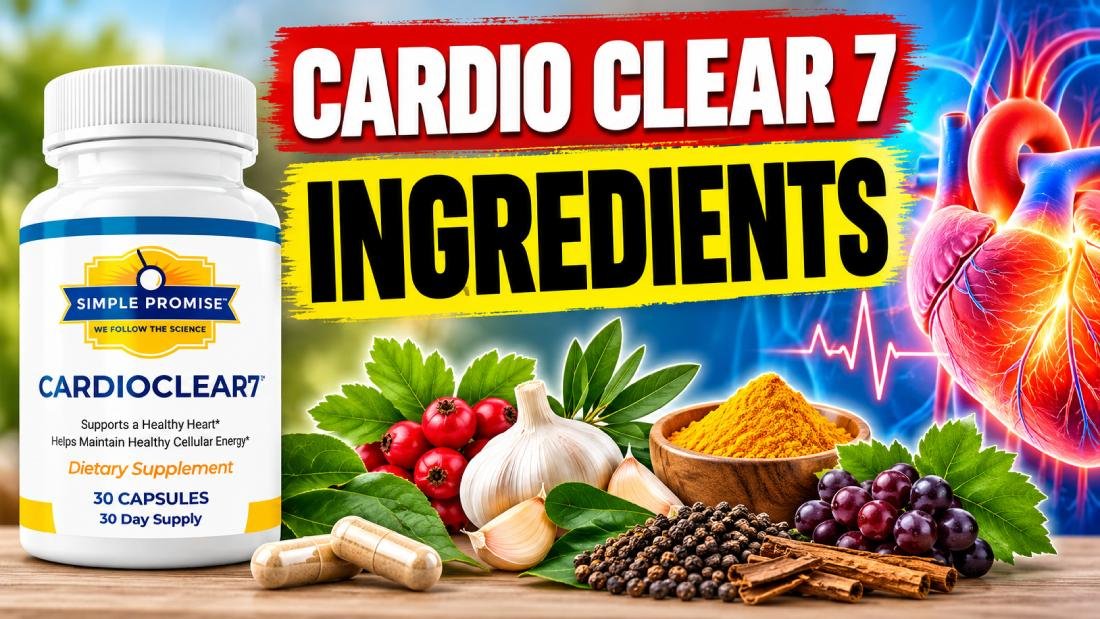
If you’re researching Cardio Clear 7, the ingredient list is probably the first thing you want to understand clearly. This article walks through what’s actually in the formula according to the official product page, what each ingredient is, why the manufacturer includes it, and what independent scientific research — separate from the marketing — says about each one individually.
We’ll also cover whether exact amounts are disclosed, what’s known about safety and drug interactions, and where ingredient-level research ends and proof about the finished product begins.
👉 Check the Cardio Clear 7 Official Website for the Latest Price
This article may contain affiliate links. If you purchase through a link on this page, we may earn a commission at no additional cost to you.
Cardio Clear 7 Ingredients: What’s Inside the Formula?
According to the Cardio Clear 7 official website, the formula is built around three ingredients the manufacturer refers to collectively as “Compound CSP”: CoQ10, Shilajit, and PQQ (pyrroloquinoline quinone). The positioning is that these three work together to support mitochondrial energy production, particularly in heart tissue.
CoQ10 (Coenzyme Q10):
What Is It?
Coenzyme Q10 is a compound naturally produced by the body and found in nearly every cell, where it plays a central role in the mitochondria’s process of generating cellular energy (ATP). It also functions as an antioxidant. The heart, being one of the most energy-demanding organs in the body, contains comparatively high concentrations of CoQ10.
Why Is It Included in Cardio Clear 7?
The manufacturer’s central claim is that CoQ10 protects LDL cholesterol particles from oxidation (which the page frames as the mechanism behind arterial plaque buildup) and fuels the heart’s mitochondria as natural CoQ10 levels decline with age. The page also states that CoQ10 is superior to vitamin E as an antioxidant and links statin use to reduced CoQ10 levels.
What Does Scientific Research Say?
CoQ10 has one of the stronger human evidence bases of the three ingredients in this formula, at least in a specific patient population. The Q-SYMBIO trial, a large randomized, double-blind, placebo-controlled study, gave 420 patients with moderate-to-severe chronic heart failure either 100 mg of CoQ10 three times daily (300 mg/day total) or a placebo, alongside their standard heart failure medications, for two years.
The CoQ10 group had significantly fewer major adverse cardiovascular events and lower all-cause mortality than the placebo group. A more recent 2024 meta-analysis pooling 33 randomized controlled trials in heart failure patients found CoQ10 supplementation was associated with a meaningful reduction in all-cause mortality and heart failure hospitalizations, along with improved distance on the six-minute walk test, with no increased rate of adverse events.
Separately, it’s well documented that statin medications lower circulating CoQ10 levels by blocking part of the same biochemical pathway used to make cholesterol, which is the basis for the “statins deplete CoQ10” claim on the official page.
Safety Considerations
CoQ10 is generally considered safe and well tolerated, with mild digestive upset (nausea, stomach discomfort) being the most commonly reported side effect. It has two interactions worth knowing about: it may reduce the effectiveness of the blood thinner warfarin, and it can have a mild blood-pressure-lowering effect of its own, which may add to the effect of blood pressure medications. Anyone taking warfarin or blood pressure medication should talk to a doctor before adding CoQ10.
Shilajit:
What Is It?
Shilajit is a tar-like mineral resin that seeps from rock in mountainous regions, most notably the Himalayas, formed over long periods from the decomposition of plant material. Traditionally used in Ayurvedic medicine, it’s typically purified before being sold as a supplement, and its most-studied active compounds are fulvic acid and a group of molecules called dibenzo-alpha-pyrones — not, as sometimes marketed, its broad mineral content.
Why Is It Included in Cardio Clear 7?
The manufacturer credits Shilajit with roughly doubling the effect of CoQ10 and making significantly more cellular energy available in muscle tissue including the heart, on top of general claims around energy and mental alertness. These specific multiplier figures are manufacturer claims; we found no independent, published research confirming that Shilajit doubles CoQ10’s effect or produces a specific percentage increase in heart-muscle energy output.
What Does Scientific Research Say?
Human research on Shilajit is real but narrower than the heart-health framing on the official page suggests. The most frequently cited human trial is a 2016 randomized, double-blind, placebo-controlled study in which healthy men aged 45–55 took a purified Shilajit extract (250 mg twice daily) for 90 days; the treatment group saw increases in total and free testosterone compared to placebo, with no serious adverse events reported.
Other small human studies have looked at Shilajit’s effects on fatigue-related strength retention, collagen synthesis markers, and bone density preservation in postmenopausal women with osteopenia. Reviewers of this literature have consistently noted that the human evidence base is small, drawn from a limited number of trials, and not yet confirmed by larger, independent replications.
Safety Considerations
Purified, lab-tested Shilajit is generally considered safe for healthy adults at studied doses, with mild digestive discomfort reported by a small percentage of users in trials. The primary safety concern with Shilajit as a category is product quality: raw or poorly purified Shilajit has been associated with heavy metal contamination, so sourcing and third-party testing matter.
Pregnant or nursing individuals and anyone with a hormone-sensitive condition should speak with a doctor before use, given its documented effect on testosterone levels.
PQQ (Pyrroloquinoline Quinone):
What Is It?
PQQ is a small quinone compound found in trace amounts in foods like parsley, green peppers, kiwi, fermented soybeans, and green tea, and in human breast milk. It’s sometimes described as vitamin-like because of research into whether it may be an essential nutrient, though this hasn’t been formally established.
Why Is It Included in Cardio Clear 7?
The manufacturer’s stated rationale is that, while CoQ10 fuels existing mitochondria, PQQ stimulates the growth of new mitochondria — a distinct and complementary mechanism.
What Does Scientific Research Say?
PQQ’s role in promoting mitochondrial biogenesis (the process by which cells generate new mitochondria) is supported by laboratory and animal research, including studies showing that diets deficient in PQQ reduce mitochondrial content in animals, and cell-based work showing PQQ activates a signaling pathway (SIRT1/PGC-1α) linked to mitochondrial growth.
In humans, PQQ has been studied on a smaller scale for cognitive effects, including a trial reporting improvements in some measures of cognitive function and cerebral blood flow with supplementation. PQQ also has documented antioxidant activity in laboratory studies.
Safety Considerations
PQQ is generally well tolerated in the doses studied (commonly in the 10–20 mg/day range in available research and commercial products), with no major safety signals reported in the available literature. Because human research is still limited in scope and duration, long-term safety data is less extensive than for CoQ10. As with any supplement, anyone on prescription medication or with a chronic health condition should check with a healthcare provider first.
✅ Check the Latest Cardio Clear 7 Price on the official website
Are Cardio Clear 7 Ingredients Backed by Scientific Research?
| Ingredient | What Research Has Investigated | Evidence Limitation |
|---|---|---|
| CoQ10 | Reduced mortality and hospitalization in a 420-patient heart failure trial at 300 mg/day; confirmed in a 2024 meta-analysis of 33 trials | Evidence is strongest in diagnosed heart failure patients at a specific high dose; Cardio Clear 7’s CoQ10 amount is undisclosed |
| Shilajit | Increased testosterone in a 90-day human trial; smaller studies on fatigue, bone density, collagen markers | No published human cardiovascular trial; reviewers describe the human evidence base as small |
| PQQ | Mitochondrial biogenesis shown in animal/cell studies; some human cognitive research | Limited human cardiovascular research; mechanism is plausible but not directly tested for heart outcomes |
Across all three ingredients, the pattern is consistent: real, published research exists at the ingredient level, ranging from strong (CoQ10 in heart failure patients) to preliminary (PQQ’s cardiac relevance), but no clinical trial of the Cardio Clear 7 formula itself has been published. Ingredient-level evidence, however credible, is not the same as finished-product proof.
Are Cardio Clear 7 Ingredients Safe?
Each of the three ingredients has a generally recognized safety profile at commonly studied doses, but there are specific interaction points worth knowing:
- CoQ10 may reduce the effectiveness of the blood thinner warfarin and can modestly lower blood pressure, which may compound the effect of blood pressure medications.
- Shilajit carries a sourcing-related risk (heavy metal contamination in poorly purified products) rather than an inherent risk from the compound itself, and it has a documented effect on testosterone that’s worth knowing about for anyone with a hormone-sensitive condition.
- PQQ has a comparatively thin long-term human safety record simply because it’s a newer research subject, though no major red flags have emerged in the studies conducted so far.
- Because exact amounts aren’t disclosed, it’s not possible to precisely predict how Cardio Clear 7 interacts with any specific medication or condition compared to the doses used in the studies above.
Anyone taking statins, blood thinners, blood pressure medication, or managing a chronic condition should talk to a healthcare provider before starting Cardio Clear 7 — not because any single ingredient is inherently dangerous, but because CoQ10 in particular has documented, clinically relevant drug interactions. No supplement, including this one, should be treated as a substitute for prescribed heart failure or cardiovascular medication.
Cardio Clear 7 Ingredients — What We Know and What Remains Unclear
What is clearly disclosed:
- The three core ingredients: CoQ10, Shilajit, and PQQ
- The manufacturer’s stated purpose for each ingredient
- One capsule taken daily
- U.S.-based, GMP-facility manufacturing, according to the manufacturer
What is not clearly disclosed:
- Milligram amounts of any ingredient
- Full Supplement Facts panel
- CoQ10 form (ubiquinone vs. ubiquinol) and Shilajit standardization details
- Whether a proprietary blend is used
What research can tell us:
- CoQ10 has meaningful clinical trial support specifically in diagnosed heart failure patients at a documented 300 mg/day dose.
- Shilajit has human evidence for testosterone, fatigue, and bone density outcomes, though not cardiovascular outcomes specifically.
- PQQ’s mitochondrial biogenesis effect is well supported in animal and cell research, with more limited human data.
✅ Check the Latest Cardio Clear 7 Price on the official website
Frequently Asked Questions
Q: What are the ingredients in Cardio Clear 7?
According to the official product page, Cardio Clear 7 contains three main ingredients: CoQ10, Shilajit, and PQQ (pyrroloquinoline quinone), referred to collectively by the manufacturer as “Compound CSP.”
Q: What is the main ingredient in Cardio Clear 7?
The manufacturer positions CoQ10 as the foundational ingredient, with Shilajit and PQQ described as enhancing its effects, though the official page doesn’t disclose the relative amount of each ingredient.
Q: Does Cardio Clear 7 contain CoQ10?
Yes, CoQ10 is listed as one of the three core ingredients on the official product page.
Q: What is Shilajit?
Shilajit is a mineral-rich resin traditionally sourced from mountainous regions such as the Himalayas, studied primarily for its fulvic acid and dibenzo-alpha-pyrone content.
Q: What is PQQ?
PQQ (pyrroloquinoline quinone) is a compound found in trace amounts in certain foods and studied for its role in stimulating the growth of new mitochondria.
Q: Are Cardio Clear 7 ingredients clinically tested?
Individual ingredients, especially CoQ10, have substantial clinical trial data, most notably in heart failure patients. Cardio Clear 7 as a finished formula does not currently have a published clinical trial of its own.
Q: Are Cardio Clear 7 ingredients safe?
Each ingredient has a generally recognized safety profile at commonly studied doses. CoQ10 has documented interactions with warfarin and blood pressure medication, so anyone on those medications, or with a diagnosed heart condition, should consult a doctor before starting.
Check the Cardio Clear 7 Official Website
Ingredient information, pricing, and promotions can change over time. Before ordering, visit the Official Cardio Clear 7 Website to confirm current ingredient details, supplement facts, pricing, package options, and guarantee terms.
For more on this product, see our Cardio Clear 7 Reviews, our Cardio Clear 7 Official Website guide, what we know about Cardio Clear 7 Side Effects, and Cardio Clear 7 Results.